

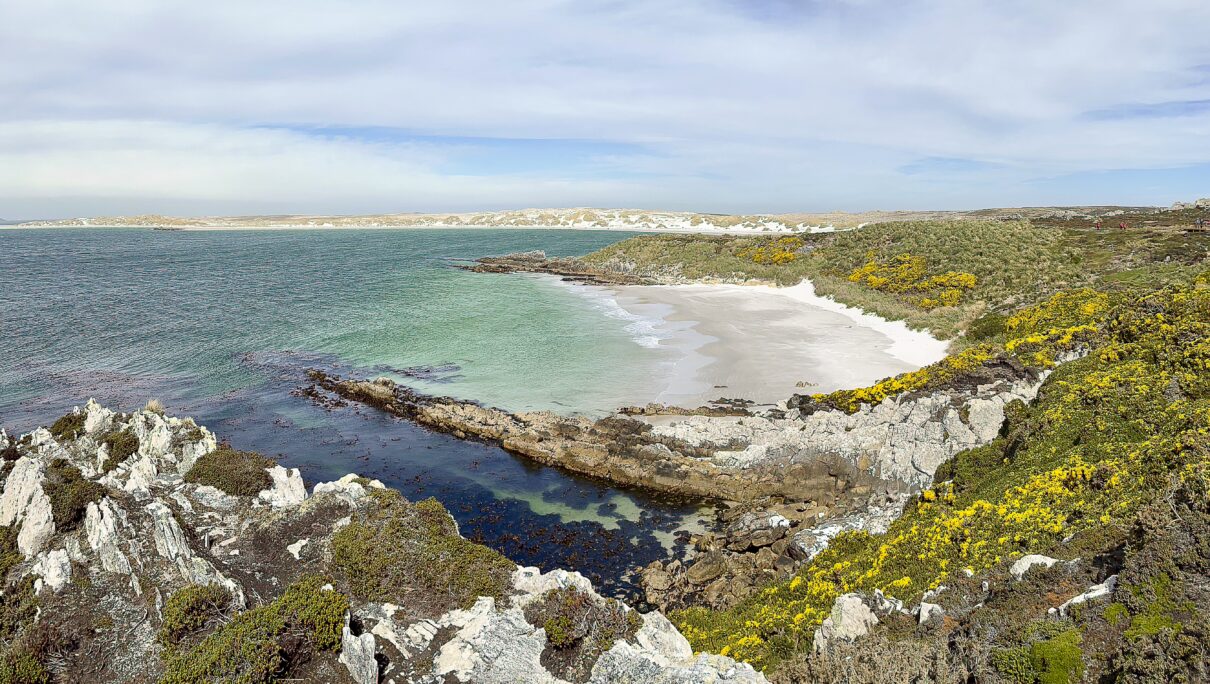
Falkland Islands — A Wild and Astonishing Archipelago
The Falkland Islands are, to me, one of the most unpredictable and enchanting places in the southern hemisphere.
Arriving here feels like landing in the middle of a poem written in landscapes — where the wind sets the rhythm, clouds paint shadows on the ground, and wildlife slowly reveals itself with both delicacy and intensity.
The archipelago is made up of hundreds of islands scattered across the South Atlantic, about 500 km off the coast of South America. From afar, it may seem peaceful. But the moment you walk through its open fields and secluded beaches, you understand that life here beats with strength and authenticity.
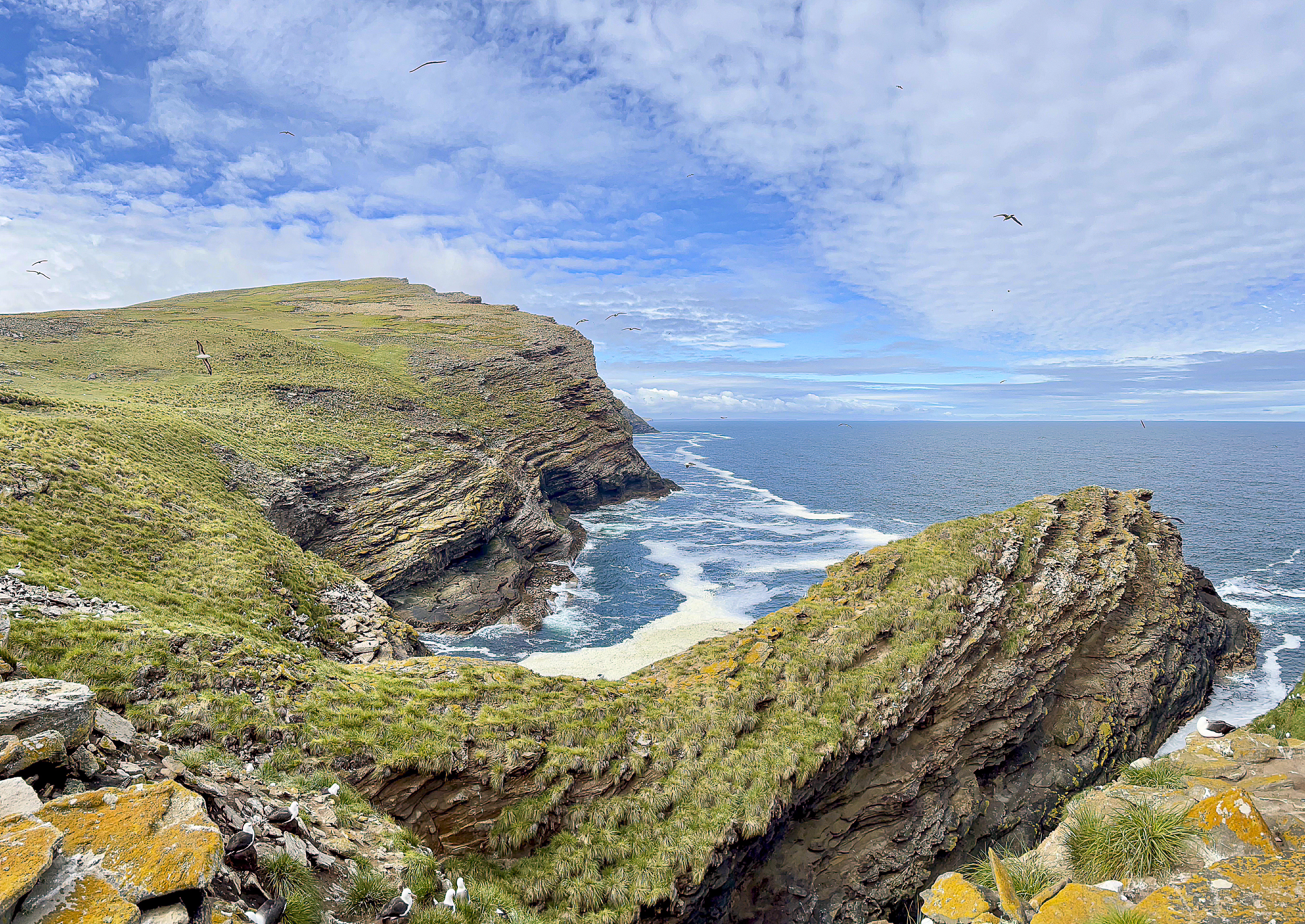
It was in the Falklands that I learned beauty isn’t only found in grandeur, but also in the smallest details — in the watchful eyes of a gentoo penguin, in the way rockhopper penguins leap across stones, in the improvised nests of albatrosses on the grass, in the sea lions sleeping tightly packed along the cliffs.
It’s a vibrant ecosystem where five penguin species share space with cormorants, kelp gulls, skuas, petrels, Antarctic foxes, and so many other birds and mammals that together create a symphony of resilience. Nature here is raw, untamed — and yet, incredibly sensitive.
On every expedition I make to the Falklands, I learn to observe more deeply and to respect more profoundly. Every animal, every nest, every silence has something to teach. I feel small before the wisdom of these lands.
There’s also something deeply human about this place: the isolation, the constant wind, the simplicity of its forms. Everything invites introspection. And photographing here becomes almost an act of listening — to space, to life, to myself.
The Falkland Islands are not just a point on the map. They are an entire universe of encounters and contrasts — a territory where nature still reigns supreme, and where every image I capture carries the urgent call to preserve what remains most pure.

The standard chunk of Lorem Ipsum used since the 1500s is reproduced below for those interested. Sections 1.10.32 and 1.10.33 from \”de Finibus Bonorum et Malorum\” by Cicero are also reproduced in their exact original form, accompanied by English versions from the 1914 translation by H. Rackham.